Insights from Expert Dialogue at the Inaugural Edition of Graft Africa’s Common Grounds Series Titled “Viable Pathways for Tackling Post-Harvest Losses in West Africa” (Held on November 8, 2025)
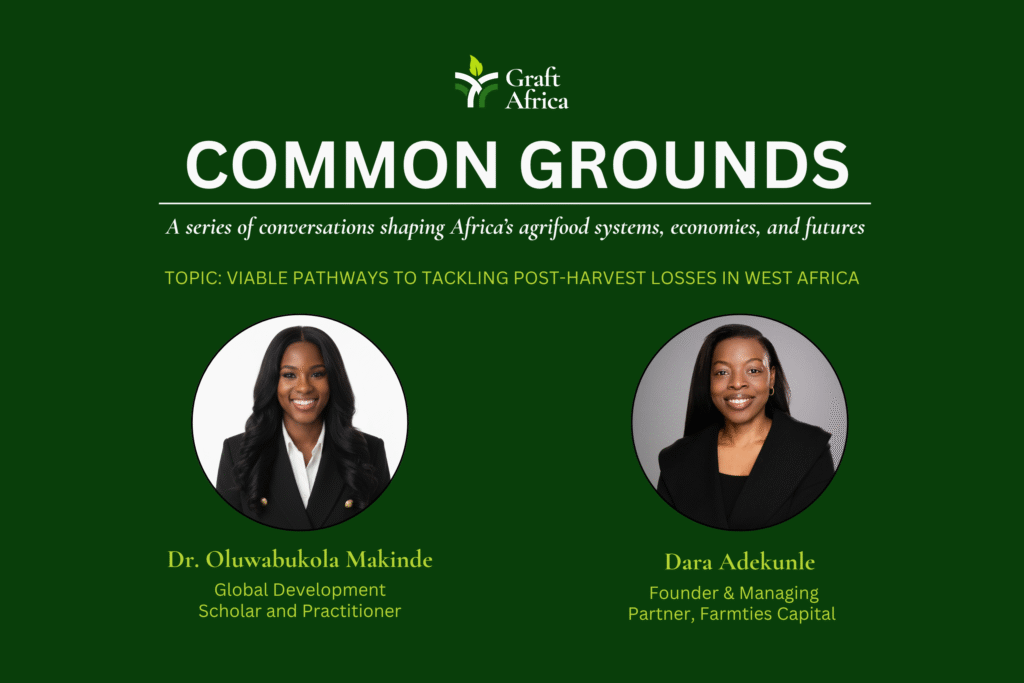
At Graft Africa, we launched the Common Grounds dialogue to open space for honest, context-rich conversations among those doing the real work of food system transformation in West Africa. We chose post-harvest loss as our first topic because it is both a technical challenge and a revealing mirror. When food doesn’t reach the market, we don’t just lose calories. We lose income, opportunity, time, and trust.
In our first session, what was intended to be a three-way panel evolved into a dynamic one-on-one conversation between Ms. Dara Adekunle, founder and managing partner of FarmTies Capital, and Dr. Bukky Makinde, a scholar and global development practitioner. The richness of the conversation revealed that post-harvest loss is not just about storage or transportation. It’s about the broader architecture of exclusion, risk, and value.
Finance as is Can’t See the Middle
“The majority of the actors and businesses that would reduce post-harvest loss do not show up in any financing systems,” Ms. Adekunle said. Her firm, FarmTies Capital, is working to close this gap by channeling capital to agrifood SMEs and aggregators that connect smallholder farmers to markets. These actors sit in what is often called the “missing middle” – they are too large for microfinance, too complex for informal lending, and too small or asset-light to qualify for commercial bank loans.
Many of these processors and aggregators are misclassified as manufacturing firms, and therefore pushed into financial products with rigid terms that don’t match their needs. “They require a lot of working capital to buy from smallholder farmers and process,” Adekunle noted. “But the machineries they have don’t meet up to the collateral requirements that are usually expected by traditional institutions.”
Why does this matter? Because without working capital, these businesses can’t buy from farmers at scale. Without capital, they can’t expand storage or manage fluctuations in demand. Without capital, they can’t anchor rural economies. This is how food loss becomes systemic.
For investors and donors alike, the message is clear: if your financial tools can’t flex to fit the people actually keeping the system alive, they will keep being left out.
Not All Middlemen Are the Same
When asked about the role of middlemen, Ms. Adekunle offered a clear distinction: “I always say middlemen – many of them don’t have a stake in the value chain. It’s always just buy and sell. But aggregators that have established themselves; they’re creating infrastructure.”
She pointed to aggregators who offer embedded services like drying, cleaning, and storage, and who take on price risk and transport logistics to ensure farmers’ produce reaches the market in good condition. These actors, she argued, must be seen as investable. “We would not fund traders. But if you’re an aggregator who cares about quality… yeah, we’ll look at you.”
This distinction is important because the language of “middlemen” often flattens the diverse roles these intermediaries play. Some extract value. Others enable it. Still, too many systems lump these actors together with short-term traders. This misrecognition is a problem of perception as much as it is a policy issue. If we want value to flow across the chain, we must learn to differentiate between those who create value and those who merely extract it. And then, we must fund accordingly.
Infrastructure Must be Designed to Match Behavior
Calls for more infrastructure are common in development circles. However, as Ms. Adekunle emphasized, infrastructure without thoughtful design often falls short. “Some of that infrastructure’s honestly not for farmers. Railways, roads (very expensive to deploy) are the things you expect the government to do.” These investments matter. However, they often don’t match how food actually moves through rural and peri-urban spaces.
Alongside large-scale investments, she advocated for expanding proven, small-scale solutions, such as solar dryers and mobile processors, as well as innovations like Purdue’s PICS bags, which extend the shelf life of grains. “The PICS bag has worked. I think it can be scaled,” she said.
The challenge isn’t a lack of innovation. It’s poor alignment and a failure to distribute and support the innovations that already work. Too often, our infrastructure agendas are top-down, capital-heavy, and disconnected from daily realities. What if we scaled the tools that farmers and aggregators are already using, rather than inventing entirely new systems from scratch? This is a call to reorient infrastructure spending around context, usability, and access, not just capital expenditure.
Inclusion Is a Systems Issue, Not a Side Note
Women, Ms. Adekunle emphasized, are central to the post-harvest landscape. They manage aggregation, lead rice parboiling clusters, and operate local mills. Yet most funding, infrastructure, and training programs bypass them. “Women play a key role around harvest and post-harvest,” she said. “In a community I worked in, the parboiling of rice is done by women. It’s almost like an abomination for a man to parboil rice.” Designing programs without considering these embedded roles leads to structural exclusion. It also wastes resources.
Dr. Makinde built on this point, emphasizing that gender-responsive design must move beyond token inclusion. These women aren’t waiting to be empowered; they are already leading. “They can adopt technology,” Ms. Adekunle added. She explained that in one of the communities where she worked, a woman actually owned a mini rice mill and was leasing it out to community members. So, these women are already entrepreneurs and supply chain nodes. Dr. Makinde further underscored that inclusion doesn’t mean inviting women in after the fact. It means starting with who is already doing the work and building around their realities.
If funding, infrastructure, or training isn’t reaching them, the system isn’t neutral. It’s misaligned.
Trust Requires Data and Context
Dr. Makinde asked a critical question: how can we unlock new capital without credible data? Poor record keeping and fragmented systems have long been cited as barriers to agricultural investment. Without data, it’s challenging to make a compelling case for investment. It’s hard to understand impact and build trust.
Ms. Adekunle agreed, but highlighted a shift. “Record keeping is something that needs to be part of business,” she said. Fortunately, more farmers are beginning to recognize the value of traceability, especially as new regulations emerge. “Farmers in Kano are calling to say, ‘Oh, we heard about the EU regulations. We want to adopt. We need technical support to help us align.’”
She explained how farmers are already utilizing digital tools where available, including weather alerts, WhatsApp groups, and simple accounting apps. The interest is there. The bottleneck is not a lack of willingness, but rather affordability and relevance. Farmers are not necessarily resistant to change. But they need infrastructure and support to adapt.
We don’t need generic data systems. We need ones that start from what farmers are already tracking, and help them prove their worth to markets and funders. Private extension services and input providers have a crucial role to play in building this capacity from the ground up.
Financing to Fit the Context
As donor funding becomes more constrained, Ms. Adekunle sees blended finance as one of the few viable paths forward. “We’re beginning to see that innovative financing is coming into play… Blended finance is really what is needed in the space,” she debated. She described how multilateral institutions, national governments, and private investors can collaborate to co-finance agricultural solutions through tools such as guarantees, matching funds, and concessional capital.
But even blended finance must evolve. Production financing is not the same as aggregation financing. Export processing requires different risk models than local market sales. Yet most funding is structured as if agriculture is one activity, rather than a series of interdependent steps. As Ms. Adekunle said. “If you deploy capital in a way that works with the values (of the system actors), then you’ll be able to deploy that capital.”
This means moving beyond rigid loan structures and exploring more adaptive tools: profit sharing, invoice financing, supply chain credit, or other models that match real business behavior. These models already exist in other sectors. What’s needed is the willingness to apply them in agriculture, with all its seasonality, price volatility, and informality.
She also emphasized that well-organized farmer cooperatives can become investable. However, they need to function as real businesses with structure, leadership, and accountability. That shift requires long-term capacity building, not just one-off grants.
Looking Forward
This conversation did not end with a call for more projects. It closed with a call for better design. Capital must see what is already working. Technology must follow behavior. Policy must do more than name the right actors; it must resource them. One thing became clear from this dialogue: agriculture doesn’t fail because people don’t care. It fails because our systems don’t match our realities.
Dr. Makinde captured the dilemma: “We can’t just slap on technologies or financing. There are deep layers we need to excavate to create a strong foundation.”
At Graft Africa, our objective is to surface and support the solutions already in motion across the region. This conversation sharpened that aim. The people who know how to solve post-harvest loss are already doing the work. They are not waiting to be discovered. They are waiting to be recognized, financed, and scaled.
So we close with questions for our community:
- If you fund agricultural initiatives, how are you evaluating value? Are your financial models structured to accommodate volatility and flow, or do they assume stability that doesn’t exist?
- If you design tech, are you building around user behavior or engineering ideal systems and scenarios that don’t match reality?
- If you support gender equity, are your programs or gender strategies grounded in where women already lead, or in where you think they should be?
- If you collect data, who owns it, and what power does it unlock for those producing it?
The middle is not a gap. It is a system we have refused to design for. If we are serious about resilience, justice, and scale in West African agriculture, the middle is where we begin. Not because it’s new, but because it has always been the site of value creation.